

Artificial intelligence (AI) can in future assess the quality of ultrasonic welding joints directly during production, without sensitive company data leaving the plant. This is demonstrated by the FLUSH research project, funded by the German Federal Ministry of Research, Technology and Space (BMFTR). The project partners Katulu GmbH, SUCO Robert Scheuffele GmbH & Co. KG and the SKZ – Plastics Center developed a federated learning system for this purpose, which has already been successfully deployed under real-world production conditions.
Quality Assurance in Ultrasonic Welding Taken to a New Level
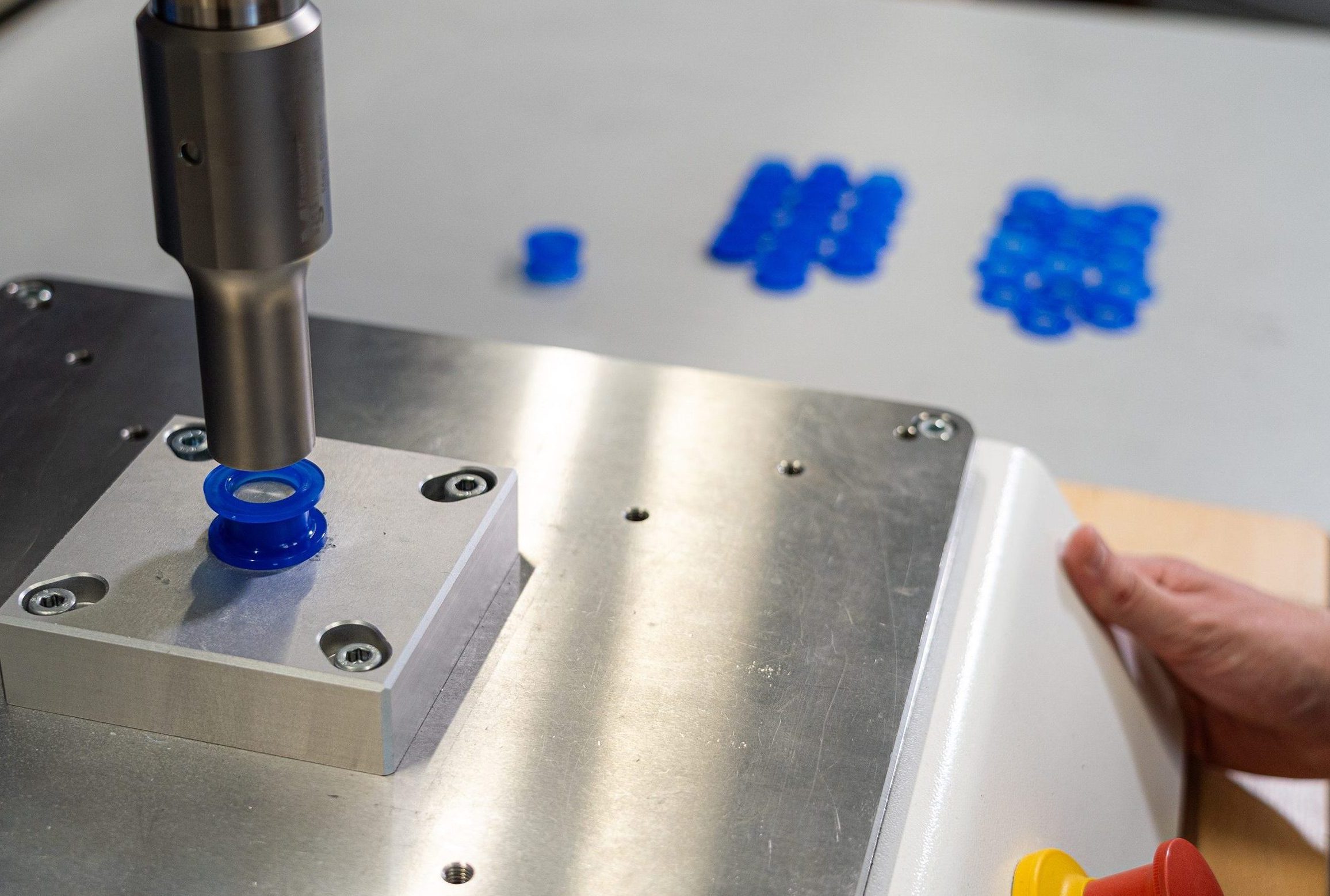
The FLUSH project (Federated Learning in the Ultrasonic Welding Process for Quality Assurance) has developed an innovative solution for the automated assessment of ultrasonic welding processes. The quality of welded joints can currently only be determined in many cases using complex and, in some instances, destructive testing procedures.
At the same time, modern ultrasonic welding systems generate large volumes of process and sensor data, which have so far only been used to a limited extent. The aim of the project was therefore to harness this data using artificial intelligence for the automated inline assessment of every individual weld.
Powerful AI with Full Data Security
The core of the approach is the use of federated learning. In this process, AI models are trained locally on the data of individual companies, with only model parameters being exchanged rather than the underlying production data. This ensures that process-relevant know-how remains fully within the respective companies, while simultaneously enabling the creation of a shared, more powerful model. This principle – machines learning from one another without disclosing data – was successfully applied to the ultrasonic welding process for the first time as part of the project.
High Prediction Accuracy Despite Decentralised Learning
The technical implementation was based on an edge infrastructure that captures process and time-series data directly at the welding systems and makes them available for model training. In particular, the use of high-resolution time-series data proved crucial to model performance. The locally trained AI model can predict weld joint strength with an accuracy of more than 90%.
The federated model achieves an accuracy that is only around 5% lower. This demonstrates that high predictive performance can be achieved without exchanging sensitive production data, while the model can continue to improve as more data becomes available. From Research to Production.
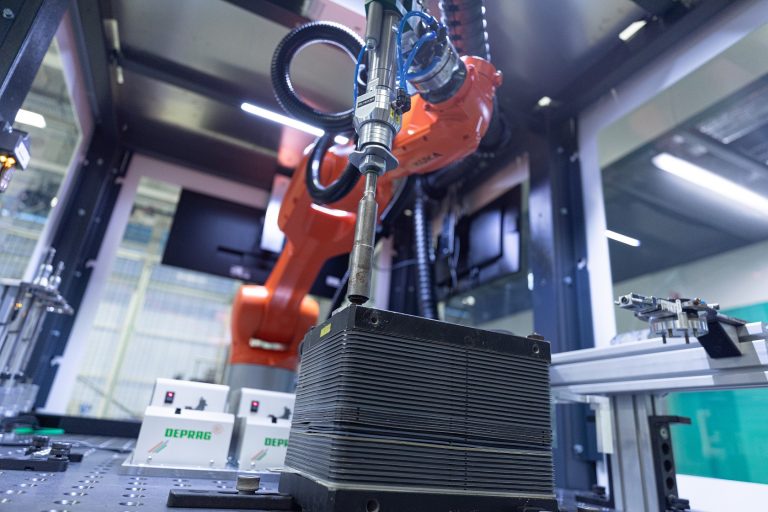
Another milestone of the project was the development and integration of a demonstrator that transfers AI-based quality assessment into the production environment in real time. The solution was implemented at SUCO and displays the predicted strength of the welds directly through an intuitive user interface. The demonstrator operates entirely locally on an edge device, requires no internet connection and can be seamlessly integrated into existing manufacturing processes.
“Particularly encouraging is the fact that the prediction accuracy of the federatively trained model falls only slightly short of that of a locally trained model. We have therefore demonstrated that data sovereignty and high-performance AI models do not have to be mutually exclusive,” says Mingo Kübert, Scientist Digitalisation at SKZ.
Pooling Expertise
The project was implemented through close collaboration between industry and research. Katulu developed the federated learning system, the AI models and the demonstrator. As the application partner, SUCO provided real-world production conditions and manufacturing data.
SKZ was responsible for the scientific and technical support of the project as well as data analysis. In addition, other industry partners contributed their requirements and practical experience to the development process.
Data-Sovereign AI for SMEs
With the results achieved, FLUSH makes an important contribution to the digitalisation of plastics processing. The approach opens up new opportunities, particularly for small and medium-sized enterprises (SMEs), to implement AI-supported quality assurance cost-effectively without having to disclose sensitive data. At the same time, the project demonstrates that collaborative data utilisation models can provide a viable path for future industrial applications.
Further data and optimisation will be required for widespread industrial deployment. However, the solution developed as part of the project provides an important foundation for future applications. Looking ahead, additional sensor data, for example from thermographic analyses, could further improve prediction accuracy and pave the way towards 100% quality monitoring.
< Back to Automation, AI, Robotics
< Back to Engineering, Industrial…
< Back to Electronics, Components

> Here is one of the places where the issuer of a news item is branded.
> Tap buttons or logos to be redirected to the issuers profiles or pages.