

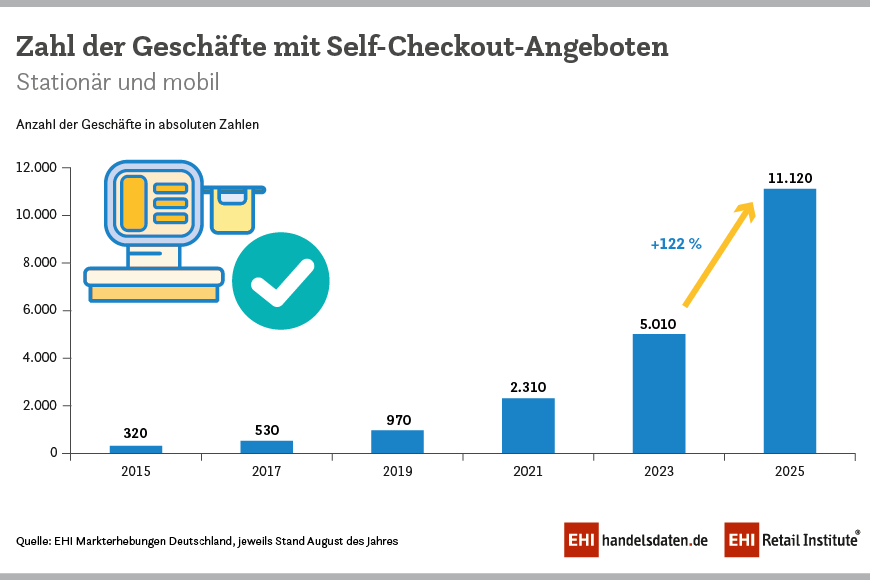
Self-checkout systems in Germany have more than doubled over the past two years. In more than 11,000 stores, customers now have the option to handle the scanning and payment process themselves – often even with various options. “Retailers see scanning items at the checkout or via mobile at the shelf as an additional customer service, because it shortens waiting times or avoids the tedious repacking at the checkout. Staff shortages in particular have accelerated the spread of such systems,” explains Frank Horst, Head of the EHI Self-Checkout Initiative and expert on inventory discrepancies at EHI.
More self-checkout than self-scanning
In 11,120 stores, customers can check out themselves. The EHI market survey documents stationary self-checkout terminals in 10,366 stores and self-scanning systems in 3,646 stores. The latter either using a hand scanner, a scanner on the shopping cart, or an app on the customer’s own smartphone. In around 2,900 stores, customers can choose between at least two self-checkout variants.
Over the past two years, the number of retail stores with stationary self-checkout systems in Germany has increased by 143 percent. Mobile self-scanning systems recorded growth of 69 percent.
Grocery retail is the frontrunner
Grocery stores, drugstores, and DIY and home improvement stores are best suited for self-checkout due to their customer structure, customer frequency, and basket size, as they offer the greatest benefits to customers. Grocery retail is the frontrunner: 60 percent of all stores with stationary self-checkout terminals are still in the grocery sector. In the traditional grocery retail segment, there are now more than 6,240 stores with an average of 3.98 self-checkout terminals per store, including nearly 2,300 discount grocery stores. This means that stores equipped with self-checkout terminals have achieved a market share of well above 10 percent.
Drugstores form the second-largest group of outlets with SCO systems at 21 percent. Of the nearly 5,200 drugstores in Germany, more than 40 percent offer self-checkout terminals to their customers. DIY stores follow with 8 percent. Of the roughly 2,000 DIY and home improvement stores operated by the leading retail groups, already 880 outlets are equipped with self-checkout terminals.
More than 38,000 self-checkout terminals
In 10,366 stores, more than 38,650 self-checkout terminals are in operation within stationary self-checkout systems, almost 25,000 of them in grocery retail. Of the total 710,000 checkouts in retail in the narrower sense, every 18th checkout is now a self-checkout terminal. However, their distribution varies significantly between sectors.
Comparing the roughly 25,000 SCO terminals used in the grocery sector with the approximately 220,000 staffed checkouts clearly demonstrates that self-checkout terminals, thanks to their growth, have now achieved considerable market relevance in Germany. In addition, there is substantial market potential, as many grocery retailers are planning installations as part of refurbishments or new openings. It can also be assumed that further growth will occur in the discount segment.
Data basis:
The EHI market analysis, as of August 2025, covers retail stores in Germany, i.e., retail in the narrower sense, excluding pharmacies, craft businesses such as bakeries and butcher shops, gastronomy-related businesses, and gas stations
Definitions:
Self-checkout systems: stationary and mobile systems for self-registration and self-payment
Stationary self-checkout terminal: synonymous with stationary SCO terminal
Mobile self-scanning: mobile systems on the sales floor for self-registering goods
< Back to Business Services, Retail

> Here is one of the places where the issuer of a news item is branded.
> Tap buttons or logos to be redirected to the issuers profiles or pages.