

Vegetation fires pose enormous challenges for emergency responders worldwide — particularly in aerial firefighting operations, which have so far been carried out largely on the basis of experience. In the Forest Shield project, Fraunhofer ITWM is working together with CAURUS Technologies to develop data-driven decision support that makes aerial firefighting more precise, efficient, and safer.
At the core of the project is the combination of a mobile sensor platform by CAURUS Technologies, a prediction system, and the simulation software MESHFREE from Fraunhofer ITWM. Firefighting agent drops are evaluated and optimised in real time in order to assess their effectiveness. The result is a learning system that provides concrete support to emergency responders in planning, executing, and evaluating operations.
Large-scale wildfires are increasingly becoming a problem in Germany as well, as a consequence of climate change. Firefighting takes place both on the ground and from the air, requiring close coordination of all measures and parties involved — not only to limit property damage, but also to save lives. In aerial water drops, operational success has so far frequently depended on the experience of the pilots. Factors such as wind or the composition of the forest significantly influence the effectiveness of a drop. At the same time, every deployment counts: between drops, valuable time passes while the water tank is refilled. Current studies show that timely aerial imagery data and analysis to support emergency responders can improve firefighting effectiveness by more than 20 percent. Nevertheless, the current state of the art focuses primarily on advance simulations of optimal firefighting campaigns — not on dynamic support during live operations on the ground.
A Learning System for More Precise Aerial Firefighting
The goal is not only to analyse drops, but to actively support them, so that every drop can achieve its full effectiveness. The outcome of the project is a demonstrator that combines sensor data, simulation, and real-time predictions in a single system and presents drop efficiency in a clear and intuitive way.
The distinctive feature of the project lies in the coupling of a compact and fast real-time prediction system with powerful but computationally intensive simulation. Relatively small machine learning surrogate models — that is, simplified models that approximate complex simulations significantly faster — learn from simulation data and capture the complex drop dynamics statistically. In the field, they deliver fast predictions directly on site. The recorded real-world drop data then flows back into the simulation system and continuously improves the predictive models. The result is a learning overall system.
Intelligently Linking Simulation and Sensor Data
The drop dynamics are complex, as many factors — such as helicopter speed, drop tank opening, wind, and flame temperature — influence the firefighting effectiveness of the water. This complex dynamic can be modelled using the simulation software MESHFREE: the software simulates the path of the water droplets from the drop tank to the fire on the ground, including all environmental factors. The basis for the modelling in the simulation is data supplied by the sensor platform. This creates a Digital Twin — a virtual copy of reality. This not only allows reality to be replicated, but also enables various other scenarios and decisions to be explored (“What if?”). This extracts even more knowledge from each deployment and multiplies the predictive power of the overall system.
Sensor Technology as the Data Foundation: The CAURUS Technologies Platform
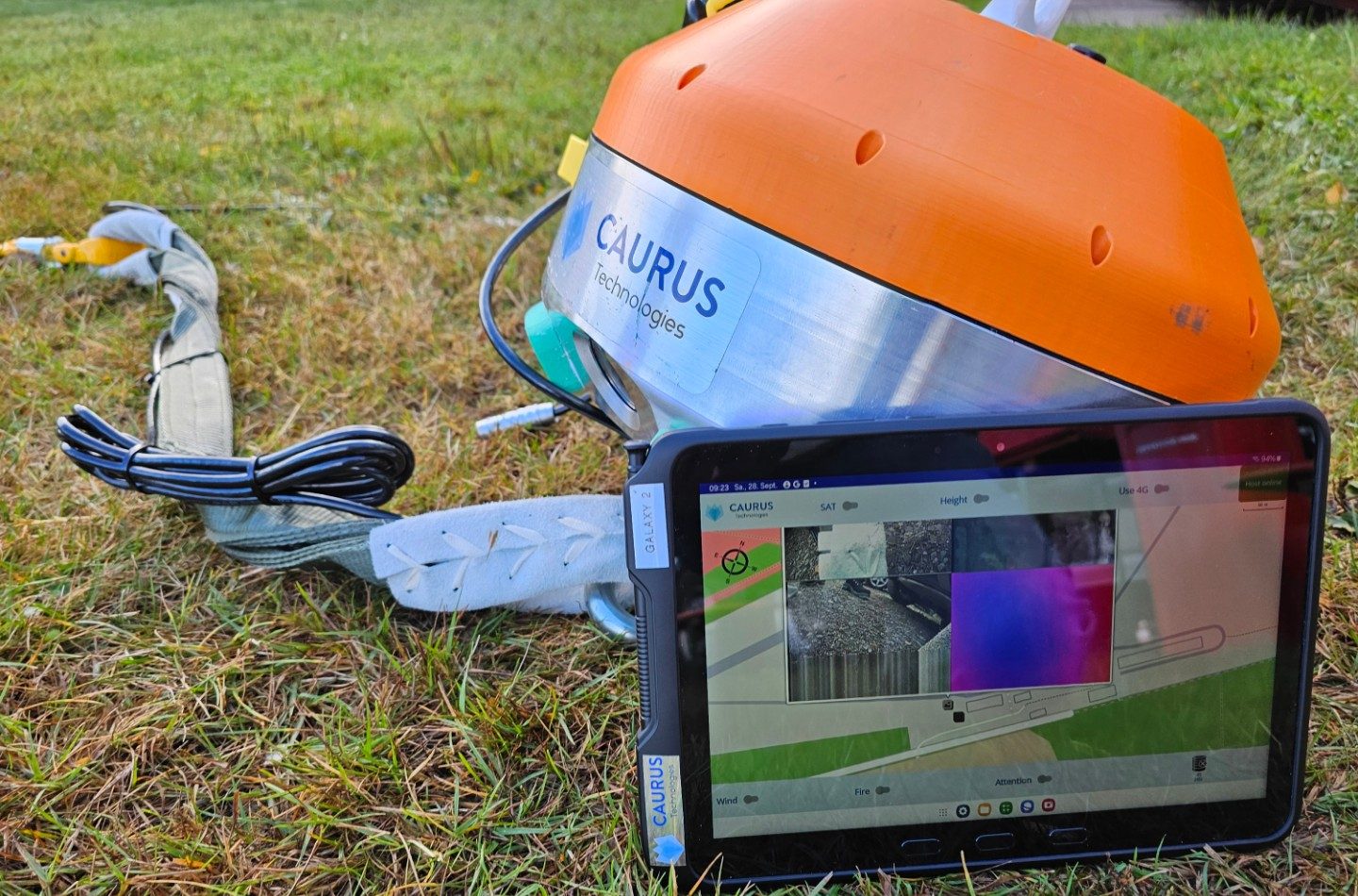
The data foundation for Forest Shield is the sensor platform developed by Fraunhofer ITWM project partner CAURUS Technologies. It is deployed during flight and captures geo-referenced image data in both the visible and infrared spectral range. A key advantage lies in its ease of use: the platform is simply attached to the helicopter alongside the drop tank — no further installation is required. It is designed to integrate flexibly into a range of carrier systems and can be operated without additional crew. It delivers high-quality data directly from the operational environment, providing a necessary basis for modelling and evaluation.
Simulation with MESHFREE
A central building block of Forest Shield is also the simulation software MESHFREE, which Fraunhofer ITWM specifically applies within the project. It is used to physically model the behaviour of firefighting agents under real operational conditions in a virtual environment. Unlike conventional methods, MESHFREE does not rely on a fixed computational grid; instead, it uses point clouds that dynamically adapt to the respective flow processes. This enables complex interactions — such as those between droplets, airflows, and environmental influences — to be simulated efficiently and precisely.
Years of experience with this technology, for example in vehicle water management, make it possible to transfer the method to vegetation firefighting and apply it to this new use case.
Operational Support Through Machine Learning in the Field
Based on the sensor and simulation data obtained, machine learning models are developed for use in the field. The compact models learn the drop dynamics statistically and enable fast predictions of the effectiveness of firefighting agent drops.
Real-time application is particularly important: emergency responders receive direct feedback on drops in the field and can base their decisions on this information. This goes beyond existing approaches, which are often limited to post-hoc analyses or pre-computed scenarios. Through the close integration of simulation and machine learning, a cloud-edge system is created that continuously learns and further improves its predictions with each new data foundation.
Outlook: Bringing Together All Stakeholder Interests in Firefighting
Forest Shield is part of the Forest Fire Fighting Transfer Laboratory (FFFLab) innovation community, which aims to bring together all parties involved beyond the fire service — such as forestry offices and nature conservation organisations. Many different stakeholder interests converge here, so that firefighting is understood as a comprehensive topic pursuing diverse objectives. This perspective is also reflected in the Fraunhofer ITWM project.
The software system is a first step towards a Digital Twin that encompasses many aspects of firefighting. In the future, all elements of the operational site are to be mapped — for example, vehicles and personnel, to improve the safety of emergency responders and affected individuals, or tree stocks, to identify zones that are particularly fire-prone or worthy of protection. The goal is a long-term learning system that continuously adapts to new operational conditions. The insights gained are intended to feed into a long-term roadmap through which additional features can be unlocked within the community and data-driven operational support can be continuously expanded for the benefit of all parties involved.
To be found at INTERSCHUTZ in the Wildfire Camp on the outdoor exhibition grounds (Stand D90 / 32).

> Here is one of the places where the issuer of a news item is branded.
> Tap buttons or logos to be redirected to the issuers profiles or pages.