

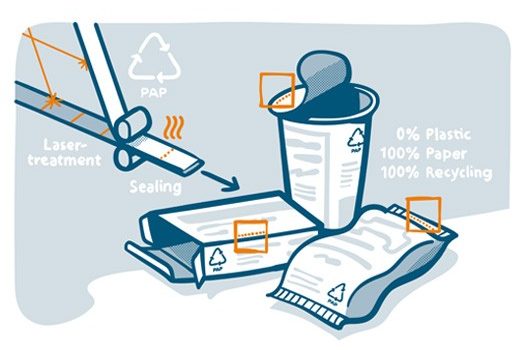
Paper packaging offers a range of advantages over its plastic counterparts: it features high recycling rates, lower CO2 emissions, and reduced disposal costs. However, it has so far been impossible to seal paper without additional adhesives or plastic layers—a distinct disadvantage for manufacturing and recycling processes. In the PAPURE project, four Fraunhofer institutes are developing a laser-based process that enables completely adhesive-free paper packaging.
As plastic packaging accounts for a large share of plastic waste, the demand for environmentally friendly packaging alternatives is growing. Paper is increasingly popular as a sustainable substitute for plastic. The problem, however, is that sealing paper packaging requires the addition of foreign materials such as adhesives or plastics. These additives contaminate the paper, complicate the recycling process, and degrade the quality of the recycled material, presenting a major challenge to an otherwise established and efficient process. In the PAPURE project, the Fraunhofer Institutes for Applied Polymer Research IAP, for Material and Beam Technology IWS, for Process Engineering and Packaging IVV, and for Machine Tools and Forming Technology IWU aim to enable adhesive-free sealing of paper packaging to improve recyclability. The institutes are pooling their expertise to develop a joining process that uses laser pretreatment to modify the paper so that it can be directly joined afterward using a heat-sealing process. The project focuses on the analysis of different types of paper and material characterization (Fraunhofer IAP), laser-based surface modification (Fraunhofer IWS), the development of an innovative joining system (Fraunhofer IVV), and the establishment of an industry-oriented demonstrator (Fraunhofer IWU). At Fraunhofer IWU in Dresden, a lab-scale production line is being built to replicate the process for manufacturing a typical packaging product.
Paper composition influences adhesion properties
In the first step, researchers at Fraunhofer IAP are characterizing coated and uncoated papers for packaging applications, as well as printer paper and cardboard, to determine whether they are suitable for joining without applying foreign materials. Around three dozen types of paper are available for testing. Particular attention is paid to identifying the hemicellulose, cellulose, and lignin content of the papers, as these significantly influence the adhesive properties of the materials as well as the quantity and composition of the resulting cleavage products (reaction products from the laser pretreatment). Using analytical methods such as scanning electron microscopy (SEM), high-performance anion-exchange chromatography (HPAEC), and X-ray photoelectron spectroscopy (XPS), the chemical composition and morphology of the different papers are examined before laser treatment, along with the reaction products afterward. Dr. Robert Protz, a scientist at Fraunhofer IAP, explains: “Too high a proportion of inorganic compounds, such as talcum and calcium carbonate, has a negative effect on the adhesive properties and the bond strength of the joint seams. Furthermore, thicker papers generally tend to be better suited for a binder-free joining process.” The researchers were able to show that commercially available standard papers can be used for the joining process if they are thicker, such as those used for producing disposable paper cups and other food packaging.
Functionalizing paper with a CO laser
In the next step, researchers at Fraunhofer IWS irradiate the surface of the paper with a carbon monoxide laser (CO laser), heating the paper abruptly and converting its main components—lignin, hemicellulose, and cellulose—into short-chain compounds in a controlled manner. It is this innovative process step that makes adhesive-free paper joining possible. After irradiation, meltable cleavage products remain on the paper surface, which can then be joined directly using heat and pressure in a heat-sealing process. “By irradiating the paper with a CO laser, we generate meltable, sugar-like reaction products that we use instead of the otherwise required plastics or adhesives to join the paper with the heat-sealing process. In a sense, we generate our own adhesive in the form of these cleavage products,” says Volker Franke, Group Manager for Laser Micromachining at Fraunhofer IWS in Dresden. “Following the laser pretreatment, we have succeeded in using the heat-sealing process—an established thermal contact method—to compress two layers of paper with heat and pressure, creating a strong, direct material bond.”
Joint quality defined by seam strength
The project partners at Fraunhofer IVV are developing the joining system required to process the laser-treated papers containing the meltable cleavage products. To do this, the researchers incorporate the findings gathered by the teams at Fraunhofer IAP and Fraunhofer IWS regarding material properties, laser parameters, and the properties of the meltable reaction products, and how these affect bond strength. They are also testing the extent to which seam strength and tightness can be improved through appropriate joining parameters and tool geometries, transferring the results to a packaging solution with the aim of achieving market-ready joint seam properties. “Seam strength determines how difficult it is to tear open a package,” explains Fabian Kayatz, scientist and project coordinator at Fraunhofer IVV in Dresden. “By measuring the mechanical strength under different types of loads (shear test, T-peel test), we can demonstrate the influence of laser and joining parameters on the bond strength of the seams. Crucial joining parameters include the sealing time, sealing temperature, sealing pressure, and tool geometry. The fiber direction also plays a role, specifically the position of the material relative to the sealing tool.” “Ultimately, we are aiming for a seam strength that is higher than the splitting strength of the paper layers. In shear tests, we are already achieving excellent joint connections,” adds Prof. Marek Hauptmann, head of the joint project. “With a bond that is just two centimeters long and three centimeters wide, you can easily lift 20 kilograms.”
Integrating adhesive-free joining into existing production processes
At Fraunhofer IWU in Dresden, a modular, lab-scale paper-processing production line is currently being built. It replicates the process for manufacturing a flat four-side sealed pouch—a typical packaging format—in a roll-to-roll process. The core of this work is the development and integration of a laser and a sealing module into the industrial-scale demonstrator, which measures approximately six meters long, one meter deep, and two meters high. The adhesive-free joining process is adapted using industrially proven sensors (including image and moisture sensors) and a digital twin with a trained data model. The surface of the continuous paper web running through the system is first irradiated with the CO laser, producing the aforementioned cleavage products. A second paper web is then fed into the system, joined with a combined sealing and cutting tool using the heat-sealing process with four seams, and punched out into a pouch geometry. The heat applied during the joining process activates the cleavage products, creating a bond between the two paper webs. A seam measurement system installed in the line for quality control is designed to detect real-time changes in seam quality, allowing for quick adjustments to the laser and joining parameters. Dr. Christer-Clifford Schenke, scientist at Fraunhofer IWU, states: “Our goal is to produce ten packages per minute on the laboratory line by the end of the project in September 2026.”
Presentation at Interpack 2026
The practical, modular demonstrator shows that the process can be integrated into existing production processes in the future. Both the laser module and the joining tool can be used separately in manufacturing. This makes the process particularly attractive to packaging machinery manufacturers, packaging producers, and contract packers. Integrating the PAPURE technology allows companies in this industry to position themselves as pioneers in “Green Packaging.” Together with interested companies from the packaging and food industries, as well as paper manufacturers and machine builders, the project partners aim to further develop the system for high-volume production. Fraunhofer researchers will present the technology’s application potential and the system’s functionality at the trade fair within the Technology Lounge of the German Mechanical Engineering Industry Association (VDMA) in Düsseldorf (Hall 4, Stand C54).

> Here is one of the places where the issuer of a news item is branded.
> Tap buttons or logos to be redirected to the issuers profiles or pages.